

The chapel is dedicated to Mary Help of Christians and was built in 1912 by the farmer Tomesc Ploner after he recovered from a serious illness while being treated at the hospital in Innsbruck.
Interior
On the altar there is an image of the Virgin Mary and two small statues of Saint Anthony and Our Lady of Lourdes. All around, there are several richly decorated votive paintings. The walls are also adorned with the twelve Stations of the Cross.
360° View
It is possible that a smaller church had already stood on this site for some time. The present building dates back to the first half of the 18th century. The church was closed for a short period under Emperor Joseph II and was thoroughly restored in 1869, after being reconsecrated in 1859.
Interior
The Baroque high altar was created by Bartolomäus Rungger and his daughter, and the church is dedicated to Saint George and Saint Andrew. The two side altars have a Neo-Romanesque pillar structure with semicircular closed niches containing Baroque paintings: on the right, the Fourteen Holy Helpers, above which is the Coronation of the Virgin by the Holy Trinity. Each saint is identified by name in the halo. On the left: the Madonna and Saint Cassian with the nine Saints of Patience: Jerome, Job, Crispin, Crispinian, Benedict, Lucanus, Isidore, Apollonia, and Notburga.
360° View
The chapel has been rebuilt several times in different locations. In 1947, the innkeeper Milio Ellecosta had it constructed in its current position due to the road. It is dedicated to Our Lady of Lourdes.
Interior
Inside the chapel there is a richly decorated tuff altar with a statue of the Virgin Mary of Lourdes placed in a niche.
360° View
The chapel next to the Festl inn has been rebuilt several times: in 1836 it was swept away by a landslide. It was rebuilt in 1841 due to a livestock epidemic. In 1911 it had to be rebuilt once again. It is dedicated to Saint Mary Help of Christians.
Interior
On the 17th-century altar there is a painting depicting the Mother of God, with Saint Elizabeth and Saint George below. Next to it are statues of Saint Sebastian and Saint Anthony.

It is said that this wayside shrine was erected around 1750 by the inhabitants of the Gran Ciasa. The reason is not known, but in the past a Gospel was read there during processions.
Interior
Today, there is a painting of the Sacred Heart of Jesus with the village of Pieve below, created by the artist Anton Rungger.

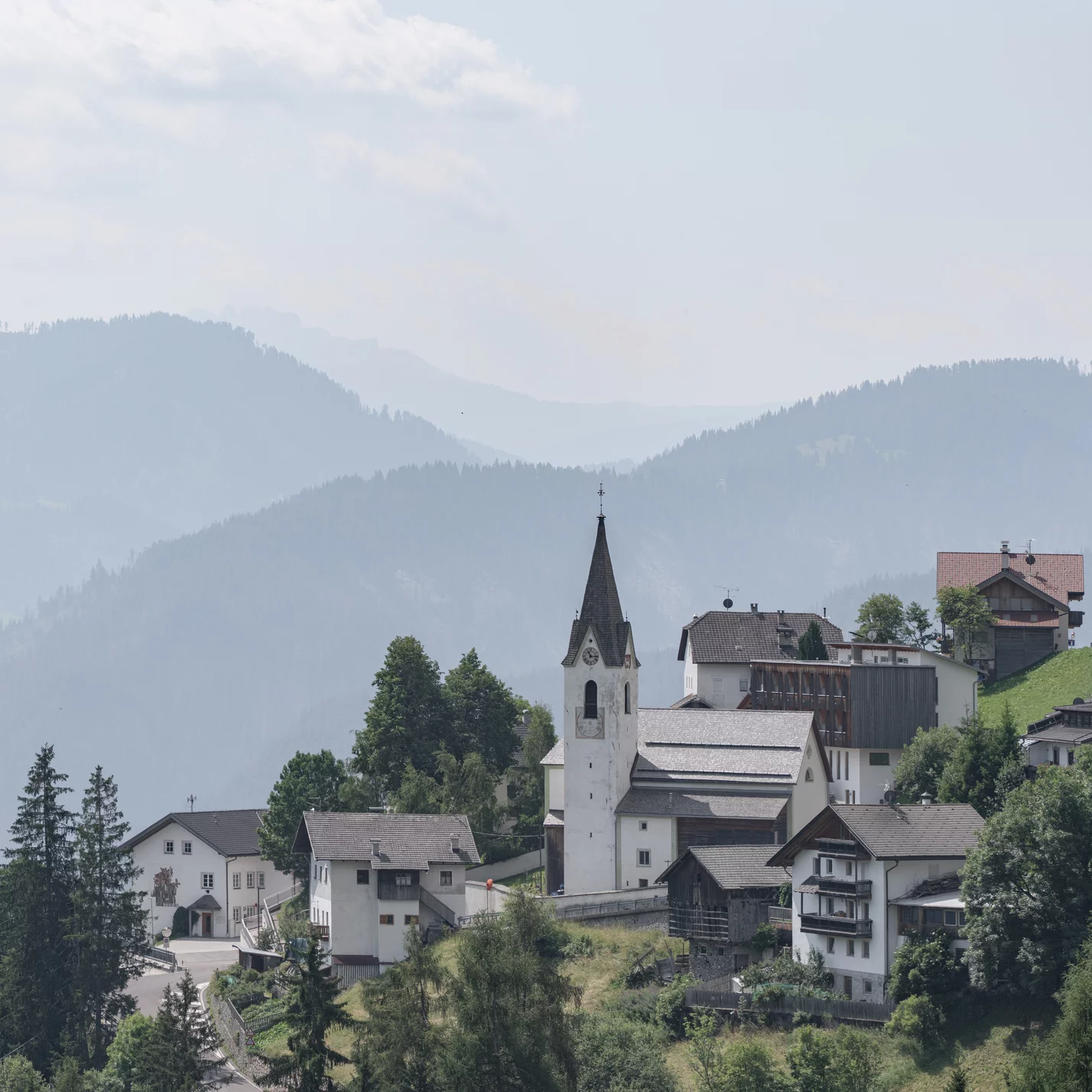
The church is dedicated to Our Lady of Good Counsel. It has a long history: the presbytery and the tower are Gothic, while the interior is Baroque. The inhabitants of Val Badia and Val Pusteria make pilgrimages to this place of worship. The people of Monguelfo hold this Madonna in particular veneration. In 2036, the fifth votive panel will be carried in procession.
Interior
In the Gothic presbytery there is an altar in Baroque style, whose core consists of the old Rosary altar by the Mirió brothers. Around 1900, Bartolomäus Rungger rebuilt the altar and transformed it into a high altar, adding a second column on each side, a new tabernacle, a depiction of the Trinity at the top, and a small statue of the Virgin Mary at the center. Some of the various statues come from the original Baroque altar.
The people’s altar and the ambo were designed by Franz Kehrer. The side altars with panels by Christian Renzler are Baroque. The Rosary altar now exists only as a painting surrounding the oldest Rosary image by Giovanelli. The Holy Cross altar was rebuilt by Filippo Tavella around 1800.
The pulpit is an early work by B. Rungger from around 1862, and the ceiling paintings were created by Josef Arnold around 1848. The blue mantle of the Virgin Mary sets the tone of the church. The four votive panels of the Monguelfo procession on the side walls are particularly striking.
360° View
The cemetery chapel was built around 1750 in Baroque style. Inside, there are memorials to the fallen.
Interior
Today, there is only a crucifix on the altar, after the statues depicting Death were stolen. On the ceiling, the Last Judgment by Christian Renzler is depicted. On the sides, the souls in Purgatory are represented.

The wayside shrine was erected around 1850 as a thanksgiving for the survival of a mother and her child after a difficult childbirth.
Interior
The shrine was recently restored and dedicated to the Blessed family father and martyr Josef Mayr-Nusser. The statues were created by Hans Rindler.

The first church is mentioned in 1436 and was later expanded in 1712. Around 1830, the bell tower was raised and the gallery for the choir was built. The tower is about 40 meters high and has three bells, two of which date back to around 1600. The church was originally dedicated to Saint Nicholas, but Saint Florian was added at a later time. The Saint Florian procession of the parishes of Pieve and San Vigilio takes place on the first Sunday of May.
Interior
The high altar is the work of Johann Vinazer (1719) and features an arrangement of staggered columns with statues of Saint Sylvester and Saint Martin, Saint Barbara and Saint Margaret. The kneeling figures of Saint Nicholas and Saint Florian, along with an enthroned Queen of Heaven with the Child Jesus and angels, are set before a painted landscape backdrop.
The northern side altar (1732/33) by Bartolomäus Pacher depicts Christ carrying the cross, two thieves, and various symbols and scenes of the Passion. The southern altar is the oldest and appears to come from the previous building. In the central tripartite niche there were originally three statues: Mary with the Child, Saint Nicholas, and Saint Margaret.
The wall paintings are attributed to the circle of Nicola Pedevilla.
360° View
The chapel is dedicated to the Virgin Mary and was built around 1850.
Interior
The carved wooden altar was built around 1900; the older statues depict Saint Sylvester and Saint Sebastian. At the center there is an image of the Virgin Mary.

The chapel is dedicated to the Virgin Mary and was built in 1924–25. The chapel is owned by the Morlang family. The small bell was once located in the bell tower of San Cassiano.
Interior
Today, the altar features a statue of the Virgin Mary and two smaller statues of Saint Peter and Saint Paul. In the past, a plague crucifix was hung in this chapel.

This chapel dedicated to the Virgin Mary was built in 1896 and is owned by the local community. It was recently restored by the Schützenverein, and Josef Lanz arranged for the second bell, cast by Grassmayr in Innsbruck.
Interior
The Virgin Mary is placed in a grotto formed by a crown of stones. On the side walls, images of the Stations of the Cross are also displayed.

The chapel is dedicated to the Mother of God and was built in 1955 and rebuilt in another location in 1987. It belongs to the Furcia inn.
Interior
On the altar there is a figure of the Mother of God surrounded by various votive panels and the Stations of the Cross.

In 1936, on the occasion of the 300th anniversary of the Monguelfo procession due to the plague, a commemorative painting was erected. In 1992, the Schützenverein built a wayside shrine on the site.
Interior
On the shrine, the artist Tone Rungger depicts the procession from Valdaora to Pieve.

Where the Fojedöra stream once flowed, there is a small chapel called “Ciüch.” It is dedicated to Saint John of Nepomuk and was built in the 18th century.
Interior
Inside, there is an altar with an image of the Virgin Mary and statues of Saint Sebastian and Saint Roch on the sides. On one side, there is a votive panel donated by the master dyer Johann Trebo: Christ and Mary reclining on a rainbow, together with Saint Anthony, Saint Vigilius, Saint Ulrich, Saint Andrew, Saint Peter, and Saint Paul.
Twice a year, a supplication procession takes place at this chapel.


“Finanziato tramite Avviso pubblico per la presentazione di Proposte di intervento per la rigenerazione culturale e sociale dei piccoli borghi storici, da finanziare nell’ambito del PNRR, Missione 1 "Digitalizzazione, innovazione, competitività e cultura", Componente 3 "Turismo e Cultura 4.0" (M1C3), Misura 2 “Rigenerazione di piccoli siti culturali, patrimonio culturale, religioso e rurale”, Investimento 2.1 “Attrattività dei borghi”, finanziato dall’Unione europea - NextGenerationEU e gestito dal Ministero della Cultura”.